Le Site du Collectionneur - collection monnaie - timbre - billet - capsule champagne - muselet - collection diverse  1- NUMISMATIQUE - MONNAIES - COINS


- French Numismatic -

The History of the FRANC


Translated by Michael E. Ontko, Vice President of the Greater Orange County CoinClub - U.S.A.

1- Introduction

After the introduction of the Euro, it is perhaps good to recall the origins ofthe FRANC as an old symbol of the French nation..

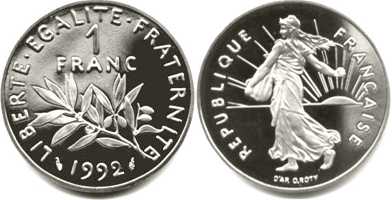
French Republic

1 franc - 1991

collectionneur, monnaie ancienne, collection monnaie : 1 franc 1991

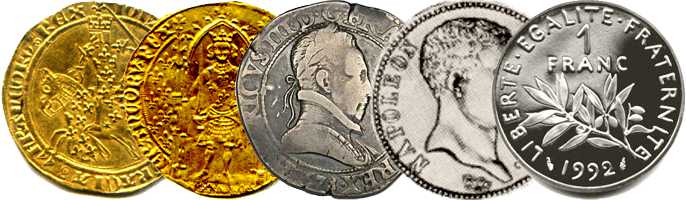
The history of the FRANC is divided into threeparts coincident with the three great periods of troubles preceding thetwentieth century: the Hundred Years' War, the Wars of Religion, and the FrenchRevolution. Numismatic history is therefore tightly linked to the history of thecountry.

2- The medieval franc

We should go back to 1360 to see the first French coin bearing the name of FRANC.This period overlaps part of the Hundred Years' War that opposed from 1337 to1453 the Valois dynasty and the English kings who claimed the throne of France.

On September 18, 1356, king John the Good was defeated with his army nearPoitiers; he was made prisoner and led into captivity. His son, the DauphinCharles, took the title of Regent and reestablished royal authority at Paris.

After a new landing at Calais by Edward III of England, a treaty of peace,prepared by the Regent at Bretigny, was signed on October 24, 1360, by the twokings. Edward III then renounced his pretensions to the throne of France andfreed king John, in exchange for territory in the southwest of France and anenormous ransom of three million gold écus.

The return of the king from captivity restored confidence. With the ordinance ofDecember 5, 1360, the coinage of silver and billon was strengthened. The act isvery important since it also deals with the creation of a new gold coin calledthe "Franc d'or à cheval" (on horseback).It is the first FRANC of monetary history.

For the ransom, a first payment of 600,000 "écus d'or" of the type"Franc d'or à cheval" was issued, thepayments were to be completed by annual installments of 400,000 écus d'orduring six years. At the beginning of 1364, no longer able to pay the ransom,John the Good was surrendered to the English and he died April 6 that year.

His son, Charles V, denounced the Treaty of Bretigny in 1369 and reconquered alarge part of the lands ceded to the English. He also struck the "Francd'or à cheval".

In 1365, the latter was replaced by a new gold coin showing the king standingwith a sword in his hand; this coin took the name of the "Francd'or à pied" (on foot).

Charles VI continued the monetary system of his father, Charles V. It isimpossible to differentiate the "Franc d'or à pied"of Charles V from those struck during the reign of Charles VI.

His son, Charles VII, had a new "Franc d'or à cheval"struck in 1422. With this coin ends the series of gold FRANCS.

2.1.The "Franc d'or à cheval"

On December 5, 1360, king John decreed the striking of gold pennies called"Franc d'or", of the face value of twentysols tournois or one livre tournois. This coin weighed 3.877 grams and wasstruck to the standard of 63 pieces to the gold mark.

King Jean le Bon

1360

"Franc d'or à Cheval"

collectionneur, monnaie ancienne, collection monnaie : franc d'or à cheval

In the context of continual conflict with England, and knowing that the coinagewas destined to pay the king's ransom, the "Francd'or à cheval" is full of symbolism.

First of all is the name: the word "FRANC"meant "free", the king returned from captivity is finally free, as hedeclared in the decree, "Now that we are free and liberated forever…."

Then there is the symbolism of the engraving: king John is shown galloping onhorseback, sword in hand, ready to strike, as he had sworn not to lay down armsuntil he had retaken from the enemy the conquered lands.

The symbolism was certainly inspired by the gold "George" florin,struck in 1341, on which his father Philip of Valois was shown galloping onhorseback and spearing with his lance the dragon of England.

King Charles V

1364

"Franc d'or à Cheval"


collectionneur, monnaie ancienne, collection monnaie : franc d'or à cheval 1364

This is a rare variety described but never beforeillustrated. A chain connects the sword to the armor of the king, the sheath ofthe sword hangs from the horse's dress.

2.2.The "Franc d'or à pied"

On April 20, 1365, it was decreed in the name of the king Charles V themanufacture of the new gold Francs known as "Francsd'or à pied" with the value of twenty sols tournois (one livretournois). This coin, lighter than the "franc d'or à cheval", weighed3.824 grams and was struck to the standard of 64 pieces to the gold mark.

King Charles V

1364

"Franc d'or à Pied"

collectionneur, monnaie ancienne, collection monnaie : franc d'or à pied

The king is shown in a less warlike fashion. He is standing, holding in hisright hand a sword and in his left hand the hand of justice.

Charles V had these coins struck at three new mints: Limoges, Poitiers and LaRochelle. The mints are identified by the mint-marks used during the Englishoccupation.

Charles V

1364

"Franc d'or à Pied" of La Rochelle

collectionneur, monnaie ancienne, collection monnaie : franc d'or à pied La Rochelle
  • L : for Limoges

  • P : for Poitiers

  • R : for La Rochelle

Charles VI, at the beginning of his reign, struck coins of the type "àpied" but they are indistinguishable from those of Charles V.

____________________

One should note the numerous imitations of both types issued by neighboringprinces (the count of Flanders, the count of Hainaut, the duke of Brabant, theduke of Brittany, the duke of Aquitaine, the count of Provence, etc.)

All these coins used the motto that first appeared on the gold coins of thecrusading king Louis IX, "Christ Vincit-Christ Regnat-Christ Imperat"(Christ conquers, Christ rules, Christ commands).

3- The silver francs of the fifteenth century

This period, between 1575 and 1586, unfolded during the Wars of Religion (to thenumber of eight between 1560 and 1598) where Protestant opposed Catholic in abloody civil war.

Henry III, with the ordinance of May 31, 1575, created a new silver coin withthe value of 20 sols tournois (one livre tournois). The gold écu was set at 60sols; this coin of 20 sols was struck in .833 fine silver with the weight of14.188 grams.

Henri III

1583

Silver Franc of Toulouse

collectionneur, monnaie ancienne, collection monnaie : franc d'argent 1583 Toulouse

This coin corresponded to the value of the medieval gold Franc,naturally, the coin took the name of "Franc d'argent"(silver franc).

The Franc equaled 1/3 écu, the half franc 1/6 écuand the quarter franc 1/12 écu.

Henry II of Navarre (the future Henry IV) also had them struck at his mints ofPau and St.-Palais.

Henri II de Navarre

1579

Silver Franc of Pau

collectionneur, monnaie ancienne, collection monnaie : franc d'argent Pau 1579

Due to constant clipping, the coinage of Francs wassuspended for good on October 13, 1586, although mints held by the CatholicLeague continued after the death of the king ot strike Francsin his name.

Despite some patterns of Henry IV (1589-1610) and Louis XIII (1610-1643), the Francwas used only as a money of account; only half francs and quarter francs werestruck until 1642.

4- The Germinal Franc

On April 7, 1795 (18 Germinal, l'an III de la République), the NationalConvention decreed the establishment of a decimal monetary system. This systemwas called the "Franc Germinal".

On August 15 (28 Thermidor, l'an III) a new decree fixed the size of the newcoins. The unified denomination would be the Franc,composed of 100 centimes. Coins of 1, 2, 5 and 10 centimes, 1, 2 and 5 décimeswere to be issued, as well as ¼, ½, 1, 2 and 5 franc coins. The decree alsofixed the weight, diameter, composition and design of each coin.

Napoléon Bonaparte

Pattern of the year 4

of the Consulate

collectionneur, monnaie ancienne, collection monnaie : essai de l'an IV

On October 20, 1799 (29 Vendémaire, l'an VII), another decree established theuse of Francs in payments and accounts, anddemonetized the royal coinages of copper, billon and bell metal. The old silverand gold coins were still permitted.

On May 6, 1799 (17 Florial, l'an VII), accounting in Francswas made obligatory.

Bonaparte, First Consul

1 franc

An 12 W (Mint : Lilles)

collectionneur, monnaie ancienne, collection monnaie : 1 franc an 12 W

It was not until 1803 (year XI) that the first one Franccoins were issued, although lower value decimal coins were issued in 1796 (yearIV).

5- The Franc in the world

Bonaparte, who became the emperor Napoleon, annexed or "protected"most of his neighbors (Geneva, Westphalia, north Italy, the Low Countries, etc.)and introduced the French system in each one, where the main coin became "Frang","Franco", "Frank"or "Franc" as appropriate.

Félix and Elisa Bonaparte

1 franco - 1806

P. of Lucca and Piombino

collectionneur, monnaie ancienne, collection monnaie :  1 franc 1806

The need to unify monetary systems became the subject of an internationalconvention, signed on December 23, 1865, by Belgium, France, Italy andSwitzerland. This convention took the name of the Latin Union. In 1868, Greecesigned the convention, which required each country to allow the free circulationof each others coins, provided that they were of the same weight and fineness (thus,one lire = one franc).

The influence of the Latin Union spread, and many non-signing countries issuedcoins that conformed to it : Albania, Austria, Hungary, Dominican Republic, etc.

Dominican Republic

1 franco

1891 A (Mint : Paris)

collectionneur, monnaie ancienne, collection monnaie :  1 franco 1891

Of course, the Belgian and French colonies were obliged to adopt the Franc:West Africa, Algeria, Morocco, Tunisia, Cameroons, Congo, Burundi, Rwanda, Togo,Martinique, Guadeloupe, New Caledonia, New Hebrides, etc.

Madagascar

1 franc - 1948

collectionneur, monnaie ancienne, collection monnaie : Madagascar 1 franc 1848

Although most of the former colonies are now independent, one still finds Francsin use there (Ivory Coast, Benin, Burkina Faso, Mauritania, Niger, Senegal,Togo, Cameroons, Guinea, etc.).

Malagasy Republic

1 franc - 1981

collectionneur, monnaie ancienne, collection monnaie : 1 franc 1981 Madagascar

6- The countries that have submitted to theinfluence of the franc on the coins

6.1 As a result of the Napoleonic conquests

6.2 As a result of the French influence in the early19th century

6.3 As a result of the Latin Union

6.4 As a result of the  World War Two

6.5 As a result of the French colonization

6.6 As a result of the Belgian colonization

copyright - JLB - COLLECTIONNEUR 


Le Site du Collectionneur - monnaie - timbre - billet - capsule champagne - muselet - collection diverse


Le Site du Collectionneur - collection monnaie - timbre - billet - capsule champagne - muselet - collection diverse